
 By mr euro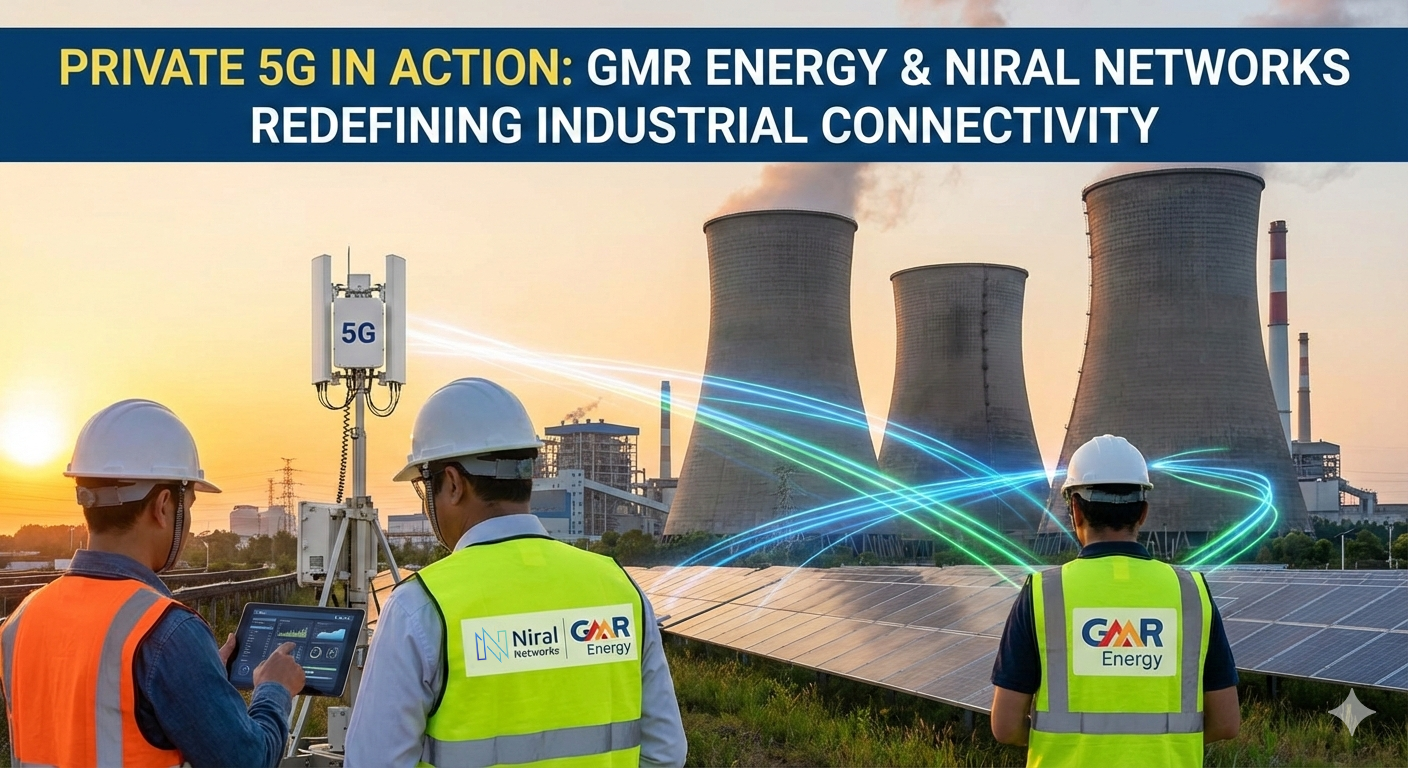
In many industrial plants, Wi-Fi looks good on paper but fails on the ground. Signals drop. Latency spikes. Safety systems cannot depend on it. Public networks are not much better. They are shared, unpredictable, and not built for mission-critical work.
This is where private 5G stops being a buzzword and starts being a necessity.
At a large 3 to 4 square kilometer energy plant operated by GMR Energy Engineering, traditional connectivity could not meet operational needs. The environment was full of electromagnetic interference. Operations were safety-critical. Teams needed real-time visibility across the plant. Delays or blind spots were not acceptable.
To solve this, GMR Energy partnered with Niral Networks to build a private 5G and edge computing platform designed specifically for industrial realities.
This was not a lab test. It was a live energy plant with real risks and real expectations.
Industrial plants are harsh environments for wireless networks. Heavy machinery creates interference. Large metal structures block signals. Running fiber across wide areas means trenching, downtime, and high cost.
In this plant, the problems were clear:
- Wi-Fi could not deliver consistent low latency.
- Fiber deployment would disrupt operations.
- Public networks could not guarantee security or performance.
- Safety systems needed instant response times.
The plant needed a network that worked everywhere, all the time, without compromise.
Private 5G met that requirement.
The solution deployed by GMR Energy and Niral Networks was designed as a full platform, not a single use case. Every part was chosen to support long-term operations.
Here is what the collaboration unlocked.
Ultra-low latency and reliability
The private 5G network delivered latency under 10 milliseconds across mission-critical zones. This matters when controlling equipment, running safety systems, or managing live video feeds. The network remained stable even in EMI-heavy areas where Wi-Fi struggled.
No trenching, no fiber headaches
Instead of laying fiber, the team used LiFi and optical wireless backhaul. This avoided digging, reduced deployment time, and kept the plant running without disruption. For large industrial sites, this is a major advantage.
Real-time operations at the edge
The platform supports live video monitoring, drone inspections, mission-critical push-to-talk, and AI analytics running at the edge. Processing data close to where it is generated reduces delay and improves decision-making.
Strong security by design
The network uses an air-gapped architecture with a 3GPP Release 16 standalone core and IMS. This means the plant’s data stays isolated and secure, with full control over users, devices, and policies.
Built to scale
The design allows multiple plants to be managed from a centralized command and control center. Policies, updates, and monitoring can be handled centrally, making expansion faster and more consistent.
Many private 5G projects fail because they are treated as small pilots. They focus on one application and stop there. This project took a different approach.
From the beginning, the network was designed as a foundation for the entire plant. New applications can be added without redesigning the system. More plants can be connected without rebuilding everything.
This is why the project stands out. It is not just a case study. It is a repeatable model for energy and industrial operators.
As Siddhartha Singh from GMR Energy explains, the vision is bigger than connectivity. The goal is a fully integrated energy plant architecture governed from a single command and control center.
That vision only works if the network is reliable, secure, and scalable.
According to Abhijit Chaudhary, private 5G succeeds only when it is designed as a platform, not deployed as a point solution.
This mindset changes everything. Instead of asking, “Can 5G support this one application?” the question becomes, “Can this network support the plant for the next ten years?”
In this deployment, the answer is yes.
Energy plants are under pressure to become safer, smarter, and more efficient. Digital transformation is no longer optional. But it must be done carefully. Downtime is costly. Safety risks are serious.
This project shows that private 5G can meet those demands when done right. It balances innovation with reliability. It respects operational realities. And it creates a clear path for future growth.
For energy operators and heavy industries, the message is simple. Private 5G is no longer an experiment. It is a proven tool for mission-critical operations.
And when it is built as a platform, it becomes a long-term advantage, not just another technology rollout.