
 By mr euro
There was a time when users were fine tapping refresh and waiting a few seconds for data to load. That era is gone. Today’s mobile users live in an always-on world shaped by instant messages, live maps, and updates that arrive before they are requested. Mobile apps have shifted from static, request-based tools to dynamic, continuously updating experiences.
Real-time features sit at the heart of this shift. They collapse the gap between action and response. You send a message and see it instantly. You book a cab and watch it move on your screen. Anything slower now feels broken, even if it technically works.
This shift is measurable. Most users prefer apps that respond immediately and keep them updated without friction. Real-time interactions reduce uncertainty, increase time spent in-app, and build habits users return to daily. From messaging and shopping to fitness and finance, instant feedback is now the baseline expectation.
This guide explains what real-time features truly mean, how they differ from traditional app behavior, and the technologies and design principles required to build reliable and scalable real-time mobile apps.
Real-time features deliver instant updates and immediate feedback without manual refresh. When server-side data changes, users see it almost immediately. The defining principle is speed combined with continuity. The system reacts as events happen, not seconds or minutes later.
At a deeper level, real-time systems remove waiting. The user performs an action and the app responds immediately, creating a smooth and uninterrupted interaction flow. For any mobile app development service provider, this capability is now a baseline expectation rather than a competitive extra.
Traditional apps rely on a request–response cycle. The app asks for data, receives a response, and disconnects. If something changes later, the app remains unaware unless it sends another request.
Real-time systems reverse this model. The app stays connected and the server pushes updates the moment something changes. This approach reduces latency, removes guesswork, and delivers a significantly more responsive and engaging user experience.
Persistent connections allow continuous communication between the app and server. They power live messaging, collaboration, tracking, and synchronized data across devices while reducing repeated handshakes and network overhead, which is critical in mobile environments.
Live chat and instant messaging enable immediate communication supported by typing indicators, read receipts, and presence status.
Real-time notifications alert users the moment something important happens, such as new messages, order updates, or security alerts.
Live location tracking continuously updates user position using GPS data and powers ride-hailing, delivery, navigation, and fitness apps.
Collaborative editing allows multiple users to work on the same content simultaneously while seeing changes instantly.
Live streaming delivers audio or video as it is recorded, requiring constant data flow and careful latency control.
Instant cloud synchronization keeps data consistent across devices, creating a seamless cross-device experience users now expect.
Real-time features directly impact both user experience and business performance.
From a user perspective, instant feedback removes friction. Users no longer refresh or question whether the app is working. Actions feel acknowledged immediately, creating trust and flow.
Real-time communication keeps conversations moving without interruption. Even small delays in time-sensitive apps can break confidence.
From a business perspective, real-time updates increase engagement, session duration, and retention. Users form habits around apps that respond instantly.
Real-time synchronization also enables collaboration at scale by eliminating version conflicts and coordination overhead. In competitive markets, real-time capability is often what separates modern apps from those that feel outdated.
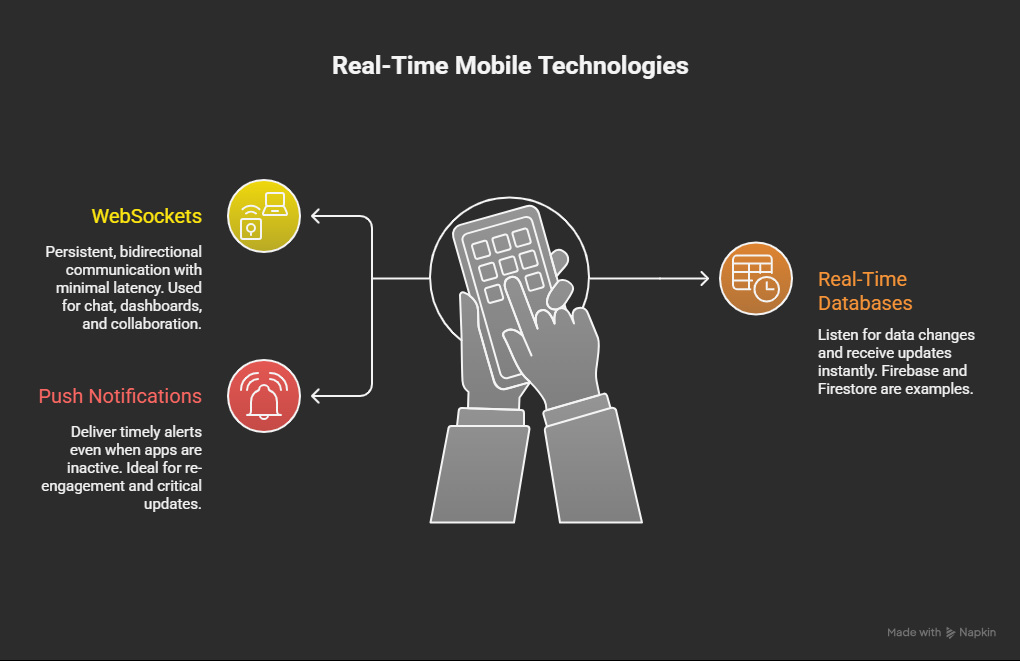
WebSockets enable persistent, bidirectional communication between client and server. After an initial handshake, data flows freely in both directions with minimal latency. They are widely used for chat systems, live dashboards, and collaboration tools.
Services like Firebase Realtime Database and Cloud Firestore allow apps to listen for data changes and receive updates instantly. Realtime Database suits lightweight, high-frequency updates, while Firestore supports structured data and better scalability.
Push notifications deliver timely alerts even when apps are inactive. They are ideal for re-engagement and critical updates, but not for continuous interaction.
Polling asks the server for updates at regular intervals. Short polling wastes bandwidth and introduces delay. Long polling reduces unnecessary requests but still relies on repeated connections.
WebSockets maintain a single persistent connection, allowing the server to push updates instantly. This reduces overhead and latency but requires careful connection management at scale.
Polling still makes sense when updates are infrequent, infrastructure simplicity matters, or persistent connections are restricted.
The right approach depends on update frequency, latency sensitivity, device constraints, and network reliability.
Client–server synchronization is the most common model, with a central server acting as the source of truth.
Offline-first architecture treats local data as primary. Users can interact without connectivity, and changes sync automatically when the network returns.
Conflict resolution is essential. Simple systems use last-write-wins, while more advanced approaches rely on versioning or timestamps. The goal is predictable behavior without surprising users.
Latency consistency matters more than raw speed. Users notice spikes more than slow averages.
Concurrency introduces race conditions and data contention. Most real-time systems rely on event-driven design and optimistic concurrency rather than heavy locking.
Scalability becomes harder with persistent connections. Intelligent load balancing and non-blocking architectures are essential.
Mobile networks are unreliable by default. Real-time systems must recover gracefully through reconnection, resynchronization, and adaptive behavior.
Start with requirements, not tools. Match technologies to feature needs.
Minimize payloads, compress data, and cache aggressively. Use asynchronous processing for non-critical operations.
Adapt sync frequency based on network quality and battery state. Use delta synchronization instead of full state transfers.
Always design fallbacks. A slower experience is better than a broken one.
AI is shifting real-time systems from reactive to adaptive, enabling instant interpretation and intelligent responses.
Faster networks reduce latency and improve consistency, enabling richer mobile interactions.
Event-driven architectures and publish–subscribe models are becoming standard for scalable real-time systems.
Real-time features now define how users judge mobile applications. Apps that respond instantly feel modern and trustworthy. Apps that lag feel outdated, regardless of design quality.
For developers, real-time demands disciplined architecture and continuous optimization. For businesses, it enables deeper engagement and faster feedback loops.
Building for an always-on world is no longer optional. It is the standard modern mobile apps are measured against.
Real-time features allow mobile apps to deliver instant updates and immediate responses without requiring users to refresh the screen. These features enable live interactions such as messaging, notifications, location tracking, and collaboration by keeping the app continuously connected to the server.
Real-time features improve user experience by making apps feel faster, more responsive, and more engaging. They help increase user retention, support seamless communication, enable live collaboration, and give businesses a competitive edge in a market where users expect instant feedback.
Common technologies include WebSockets for bidirectional communication, Firebase Realtime Database or Firestore for live data synchronization, push notification services like FCM and APNs, and protocols such as MQTT or Server-Sent Events depending on the use case.
Developers often deal with latency management, concurrency issues, scalability concerns, and unreliable mobile networks. Handling offline scenarios, ensuring data consistency, and maintaining performance at scale are some of the biggest technical challenges in real-time systems.
Most modern real-time apps use an offline-first approach. Data is stored locally and synced when connectivity is restored. Conflict resolution strategies such as last-write-wins, versioning, or manual resolution help maintain data consistency when multiple users modify the same data.
Real-time features allow mobile apps to deliver instant updates and immediate responses without requiring users to refresh the screen. These features enable live interactions such as messaging, notifications, location tracking, and collaboration by keeping the app continuously connected to the server.
Real-time features improve user experience by making apps feel faster, more responsive, and more engaging. They help increase user retention, support seamless communication, enable live collaboration, and give businesses a competitive edge in a market where users expect instant feedback.
Common technologies include WebSockets for bidirectional communication, Firebase Realtime Database or Firestore for live data synchronization, push notification services like FCM and APNs, and protocols such as MQTT or Server-Sent Events depending on the use case.
Developers often deal with latency management, concurrency issues, scalability concerns, and unreliable mobile networks. Handling offline scenarios, ensuring data consistency, and maintaining performance at scale are some of the biggest technical challenges in real-time systems.
Most modern real-time apps use an offline-first approach. Data is stored locally and synced when connectivity is restored. Conflict resolution strategies such as last-write-wins, versioning, or manual resolution help maintain data consistency when multiple users modify the same data.